


How to Pick a Liquid Foundation You Won't Regret by Lunchtime

Foundation shopping has a cruel rhythm to it. In the bathroom light at 7am, your new liquid foundation looks perfect: even, fresh, exactly the shade the swatch promised. Then somewhere between the school run and your second coffee, things start to shift. It creeps into the creases around your nose. It turns a shade warmer than your neck. By lunchtime you're staring at a patchy, faintly orange version of your morning face and wondering where it all went wrong.
Most Australians who've worn makeup for more than a few years have a drawer of these regrets, foundations that auditioned well and failed on the job. The frustrating part is that the failure is rarely random. Foundations break down by lunchtime for a handful of predictable reasons, and once you know what they are, you can shop around them. Here's what's actually happening, and what to look for so your next bottle is the one you keep.
Why Liquid Foundations Fail by Midday
Oxidation: the orange shift
If your foundation looks right at application and wrong two hours later, oxidation is usually the culprit. As the formula interacts with the oils on your skin and the air around you, its pigments can darken and warm up, which is why a perfect morning match can read distinctly orange by noon. Oilier skin accelerates it, and so does layering foundation over heavy, oil-based skincare. The fix isn't buying a lighter shade to compensate, that just gives you a grey morning instead of an orange afternoon. The fix is a formula that's designed not to discolour as it wears.
Caking and creasing: the texture trap
Caking almost always comes down to weight and layering. Heavy formulas sit on top of the skin rather than melding with it, and every extra layer you add to chase coverage adds texture that settles into fine lines, around the eyes, beside the nose, across the forehead. The counterintuitive truth is that the foundations that look heaviest by lunch are often the ones that went on sheerest in the morning, because sheer coverage invites over-application. A formula with genuine, buildable coverage lets one thin layer do the work of three.
The wrong shade or undertone from day one
Plenty of lunchtime regrets were actually locked in at the checkout. A shade chosen under harsh store lighting, or matched to the back of a hand rather than the jawline, will never look right no matter how well the formula performs. Undertone matters as much as depth: a foundation with the wrong warmth reads ashy or ruddy even when the shade depth is technically close. Any brand that's serious about liquid foundation should give you proper shade-matching tools before you buy, and a safety net if you still get it wrong.
Skin that wasn't ready for it
Foundation is only ever as good as what's underneath. Applied over dry, flaky patches it clings and highlights them; applied over a thick slick of unabsorbed moisturiser it slides and separates. A minute of prep, cleansed skin, moisturiser fully absorbed, changes how any foundation wears. This one is free to fix, so it's worth ruling out before you blame the bottle.
Dewy, Matte or Somewhere In Between?
Finish is personal, but it's worth choosing deliberately rather than inheriting whatever's in the bottle. Fully matte foundations control shine but can flatten the skin and emphasise dryness and texture, particularly on mature skin. Very dewy formulas look luminous in photos but can tip into shiny by afternoon on combination skin. For most people, most of the time, the sweet spot sits in between: a fresh, skin-like finish with light-reflecting quality that reads as healthy rather than greasy.
There's also an Australian-specific consideration here: uneven tone. Clinical research has found that UV exposure appears to be responsible for around 80% of visible facial ageing, with pigmentation changes strongly tied to sun exposure. For sun-loving Australians, that means the job we're asking foundation to do is often less about colour and more about evening out sun-related unevenness, which favours formulas that blur and diffuse rather than simply coat.
The Checklist Before You Buy
Pulling that together, a liquid foundation worth your money should tick five boxes. It should offer buildable, medium-to-full coverage, so one thin layer handles most days. It should have a lightweight feel, because weight is what turns into cake. It should hold its colour through the day rather than oxidising. It should suit how your skin actually behaves, hydrating enough for dry patches, balanced enough not to slide on an oily T-zone. And the brand should make shade selection safe, with matching tools and an exchange policy for mis-picks.
One more test that most people forget: photography. Some foundations contain ingredients that bounce camera flash back as a ghostly white cast, the dreaded flashback that ruins event photos. If weddings, parties or work functions are part of your life, a formula that photographs cleanly is worth seeking out on purpose.
Where Thin Lizzy's Flawless Complexion Liquid Foundation Fits
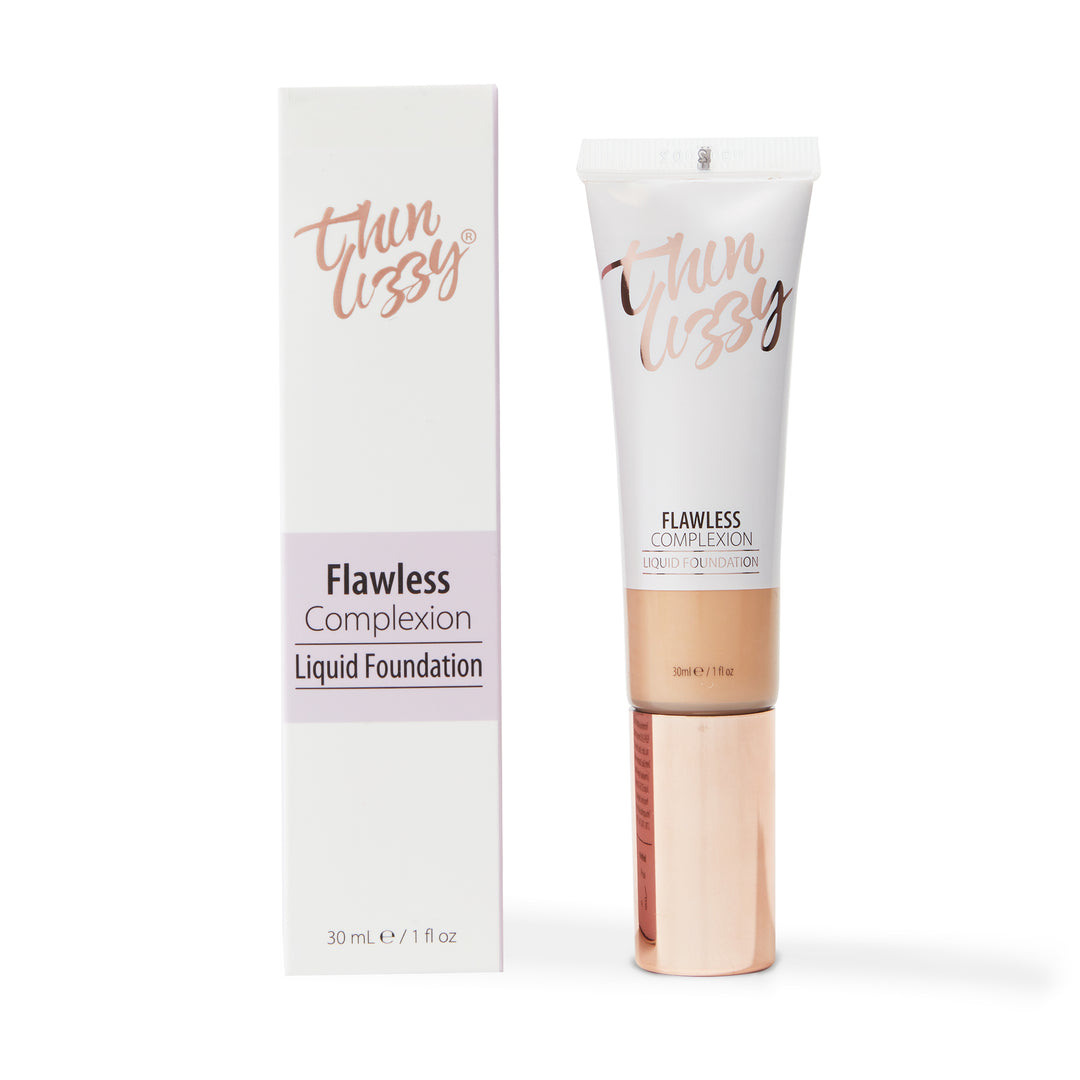
Thin Lizzy's Flawless Complexion Liquid Foundation was built around exactly these failure points. Its unique liquid formulation blurs imperfections like fine lines, minimises the appearance of pores and evens out skin tone, while being instantly hydrating, plumping the skin so it looks smooth and fresh all day. The texture is soft and weightless with a dewy, flawless finish that lasts, sitting in that in-between finish zone that flatters most skin types.
Coverage is medium to full with a 'light as air' formula designed specifically to prevent caking, which is the antidote to the over-layering trap. There are no skin-clogging ingredients like cakey powders or oily moisturisers in the formula, and the result is designed to look like natural skin, but better. It's also formulated to handle flash photography without flashback, a small detail that matters enormously the one night a year you need it.
Like the rest of the range, it comes with a 30-day money back guarantee and is 100% cruelty free, which takes most of the risk out of trying it.
Brush, Sponge or Fingers?
Application changes the result more than most people expect. Thin Lizzy designed two tools specifically for this foundation. The Blurring Brush features over 300,000 ultra-fine fibres that seamlessly blur imperfections, giving streak-free, even coverage, and it covers twice the area in half the time of a standard foundation brush. The Blending Sponge, made from silky-soft latex-free foam, gives seamless application with minimal wastage; dampen it first when applying liquid products for even, all-over coverage. Fingers work in a pinch, but reviewers consistently report the best finish comes from pairing the foundation with the brush.
Getting the Shade Right the First Time
This is where the checkout regret gets solved. Thin Lizzy's Colour Match chart walks you through finding your closest shade before you order, and the Colour Swap Guarantee means a wrong pick can be exchanged rather than joining the drawer of regrets. Match to your jawline in natural light, not the back of your hand, and when you're between two shades, remember that a touch too light is easier to warm up with bronzer than a too-dark shade is to lighten.
Making Any Foundation Last Longer
A few habits stretch the wear of whatever base you use. Start with clean skin and let your moisturiser absorb fully before applying, give it two or three minutes rather than layering immediately. Apply thin: one layer everywhere, then a second small layer only where you genuinely need more. Blot rather than wipe during the day, since wiping lifts product while blotting removes only oil. And resist the urge to fix a midday patch by piling more foundation over the top; press a small amount in with a sponge instead, and the repair will be invisible.

A Foundation You Keep, Not One You Forgive
The difference between the foundation you regret and the one you repurchase comes down to a few choices made before you ever open the bottle: a formula that holds its colour, a texture light enough not to cake, coverage honest enough that one layer is enough, and a shade matched properly with a safety net behind it.
If your current foundation isn't passing the lunchtime test, Flawless Complexion Liquid Foundation is designed around every one of those failure points, and with the Colour Swap Guarantee and 30-day money back guarantee, trying it costs you nothing but the shelf space in the regret drawer it might finally empty.
Frequently Asked Questions
Why does my liquid foundation turn orange during the day?
That's oxidation, the pigments in the formula darkening and warming as they interact with your skin's oils and the air. It's most noticeable on oily skin and with heavy layering. The reliable solution is a formula designed not to discolour as it wears, rather than buying a lighter shade to compensate.
Is liquid foundation better than powder foundation?
Neither is universally better, they suit different skin and different days. Liquid foundations typically offer more hydration and a more skin-like, dewy finish, which suits dry, combination and mature skin especially well. Powders excel at speed, oil control and touch-ups. Many people keep both: a liquid base for full days out, powder for quick days and top-ups.
How do I stop foundation settling into fine lines?
Use less product, applied thinly to well-prepped skin, and choose a lightweight formula with genuine coverage so you're not tempted to layer. Formulas that blur fine lines rather than sitting on top of them, like liquid-to-powder textures, are specifically suited to this problem, which is why they're often recommended for mature skin.
What if I order the wrong shade online?
With Thin Lizzy, you're covered: use the Colour Match chart before ordering, and if the shade still isn't right, the Colour Swap Guarantee lets you exchange it. That removes the biggest risk of buying foundation online.
