


Age Spots on Face: Why They Appear & How to Cover Them Well

One day they simply seem to be there: flat, brown, coin-edged marks on the cheeks, temples or forehead that weren't in photos ten years ago. Age spots are one of the most universal skin changes Australians see hardly surprising in a country with our sunshine and while they're usually completely harmless, they're also one of the changes people most want to smooth over.
This guide covers what age spots actually are, how to tell them apart from other marks, the one habit that genuinely deserves the word “prevention”, when a spot should be checked by a professional, and how to cover them so well the coverage is the secret.
What Age Spots Actually Are
Age spots also called sun spots or liver spots, though they have nothing to do with the liver are small, flat areas of increased pigment. Despite the name, age is only half the story: they're primarily the long-term result of sun exposure, which is why they cluster on the places that see the most light the face, the backs of the hands, the shoulders and the décolletage. Years of UV exposure prompt pigment-producing cells to make extra melanin in concentrated patches, and from midlife onward, those patches begin to show. They're flat, painless, and typically tan to dark brown, ranging from freckle-sized to a centimetre or more.
You may also hear them called solar lentigines the clinical name, and a more accurate one, since “solar” points at the real cause. Whatever the label, the mechanism is the same: sunlight, accumulated over years, showing up as concentrated pigment long after the exposure that caused it.
Age Spot, Freckle or Something Else?
Freckles tend to arrive early in life, scatter widely, and fade in winter; age spots arrive from midlife, sit in sun-exposed zones, and stay put year-round. Moles are usually raised or at least distinct in texture, and present from earlier in life. Age spots are flat, uniform in colour, and stable and that word, stable, is the important one, because it's the property that separates a cosmetic concern from something that needs professional eyes.
The Part That Matters Most: Get New or Changing Spots Checked
Before any talk of coverage, the honest Australian version of this article has to say it plainly: any spot that is new, growing, changing in colour or shape, irregular at the edges, itching, bleeding or simply looking different from your other marks should be checked by your GP or a skin cancer clinic promptly, not eventually. Australia's sun gives us more age spots than almost anywhere, and it also gives us among the world's highest rates of skin cancer, and some early skin cancers can resemble an innocent dark mark. Regular skin checks are simply part of life here, the way dental checks are. A genuine age spot will be declared exactly that in minutes, and then you can cover it with complete peace of mind which is the only way makeup and skin safety should ever be combined.
Prevention: The One Habit That Works
Existing spots are history written in pigment, but future ones are still negotiable. Daily sunscreen on the face every day, not just beach days plus a hat and sunglasses when you're out, is the single habit that slows new spots forming and stops existing ones deepening. It's unglamorous advice, and it outperforms every serum promise on the shelf. If you do want to explore fading existing pigmentation, that's a conversation for a GP or dermatologist, who can talk through professional options suited to your skin — it's not something any makeup product does, and you should be sceptical of cosmetics that claim otherwise.
How to Cover Age Spots Well
Start with an even canvas
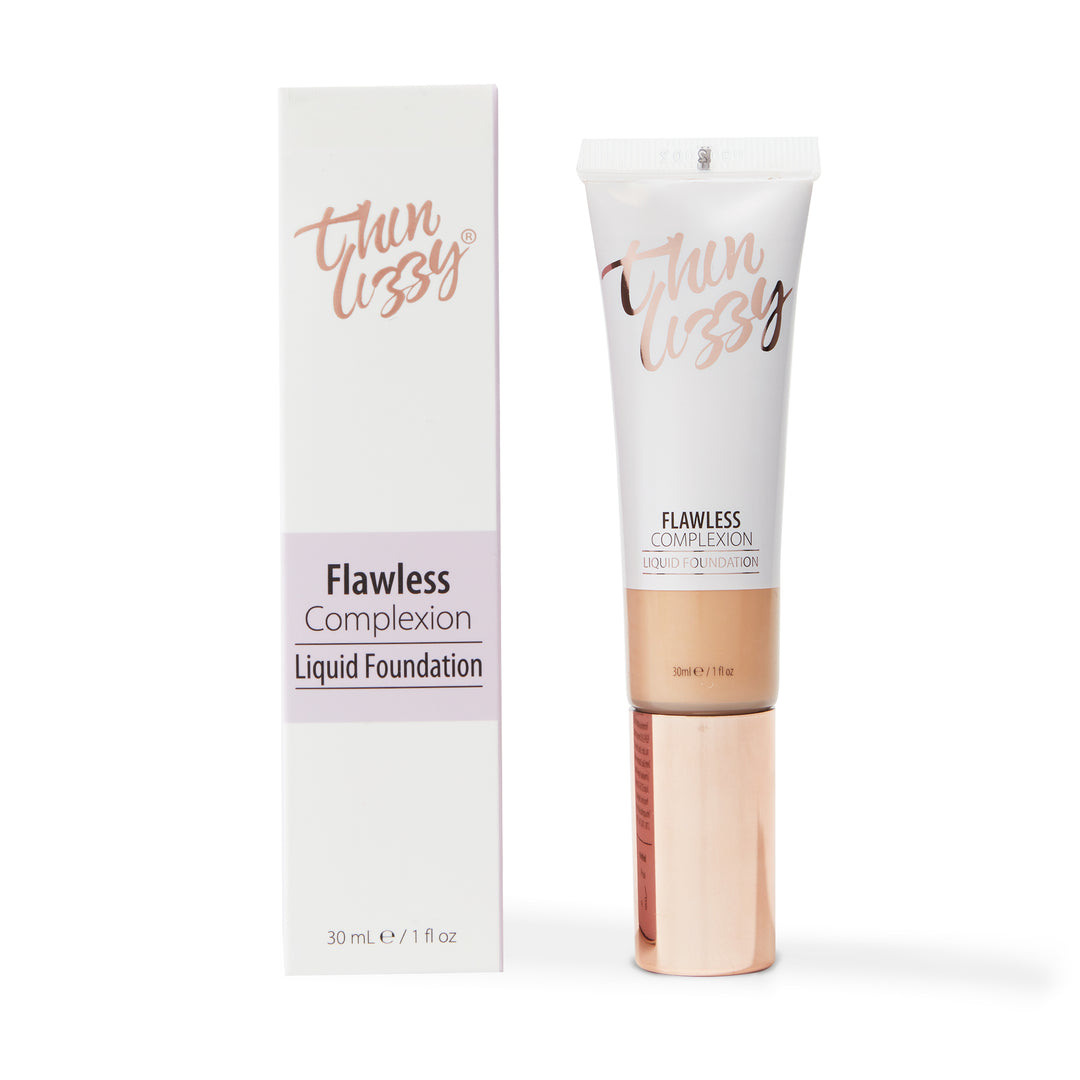
Covering individual spots on bare skin is working the hard way. A foundation that evens the whole complexion first does most of the job after it, many lighter spots vanish entirely and only the darkest few need attention. Thin Lizzy's Flawless Complexion Liquid Foundation is built for exactly this: a unique liquid-to-powder formulation that blurs imperfections, evens out skin tone and minimises the appearance of pores, while feeling weightless and hydrating rather than heavy the fullest-coverage foundation in the range, yet it reads as skin.
Spot-conceal what remains
For the spots still showing through, precision beats quantity. Concealer Crème is the specialist here a buildable, soft-touch formula made to cover everything from redness and dark circles to birthmarks and full-colour tattoos, which makes a brown age spot light work. Pat a small amount just over the spot with a fingertip or small brush, blend only the edges outward, and build a second thin layer if the spot's centre still peeks through. Because it's water, sweat and smudge resistant, the coverage holds through an Australian day.
Match the shade, then stop
Cover a dark spot with a too-light concealer and you trade a brown mark for a pale halo. Match your exact skin tone over spots the goal is invisible, not brightened. Set with the lightest touch of powder only if the area creases or rubs, and resist the urge to keep adding: a covered spot with soft edges disappears; a thickly coated one announces itself in different ways.

Don't Forget the Hands and Décolletage
The face gets the attention, but the backs of the hands and the chest log just as many sun hours often more, since they rarely see sunscreen. If matching your face to a spot-free neck and chest is starting to look like two different people, the same two-step approach works below the jaw: even the area first, then spot-conceal the darkest marks, using a water- and smudge-resistant formula so coverage survives handwashing and collars. And the prevention rule doubles here too: hands on the steering wheel and an open neckline are prime Australian sun real estate, so sunscreen on both should be as routine as it is on your face.
What Makeup Can and Can't Do
Worth saying clearly, because plenty of marketing blurs it: makeup covers pigmentation completely, beautifully, for the day and washes off at night having changed nothing underneath. It doesn't fade, treat or remove age spots, and this article won't pretend otherwise. That's not a limitation to apologise for; it's the honest division of labour. Sunscreen prevents, professionals treat, and good makeup makes the whole question invisible in the meantime. Many women, once covering takes ninety seconds, find that's all the resolution they wanted.
Frequently Asked Questions
Are age spots dangerous?
Genuine age spots are harmless pigment and need no treatment. The caution is in the diagnosis, not the spot: anything new, changing, irregular or otherwise different from your usual marks should be confirmed by a GP or skin clinic first especially in Australia, where regular skin checks are sensible for everyone.
Can age spots be removed?
Professional options exist for fading or removing confirmed age spots, and a GP or dermatologist is the right person to discuss them with. No over-the-counter makeup removes pigmentation makeup's job is coverage, and done well, coverage is often enough.
What's the best makeup to cover age spots?
An even-toning foundation across the whole face first, then a high-coverage, buildable concealer patted precisely on the spots that remain, in a shade matching your skin exactly. Thin layers, blended edges, minimal powder.
Do age spots get worse without sunscreen?
Sun exposure deepens existing pigmentation and encourages new spots the same UV that created them keeps feeding them. Daily sunscreen is what stops the collection growing.
Why do I suddenly have so many age spots?
They feel sudden, but they're decades in the making sun exposure from years past keeps surfacing as pigment from midlife onward, and a run of high-UV summers can make a batch appear close together. It's one more reason the sunscreen habit pays off long after you start it. As always, a cluster of genuinely new marks is worth a skin check for peace of mind.
The Takeaway
Get anything new or changing checked, protect your skin from tomorrow's spots with daily sunscreen, and cover today's with technique instead of thickness: Flawless Complexion Liquid Foundation to even the canvas, Concealer Crème for the stubborn few. The full scars and pigmentation collection gathers everything suited to sun-marked skin, and our guide to the best concealer for mature skin covers the creasing-free technique in detail.
